
Data centers are rapidly migrating to 800G and 1.6 Terabit (T) network speeds to support high-performance AI workloads, with hyperscalers already gearing up for 3.2T. These advanced applications leverage multi-fiber connectivity, including traditional MPOs and very small form factor (VSFF) connectors. To ensure your links can support such applications, you need a fiber tester that makes the cut.

800G, 1.6T, and 3.2T Rely on MPO Connectivity
As signaling technology advances from 100 Gigabit per second (Gb/s) lane rates to 200 Gb/s and eventually 400 Gb/s, data centers are using cost-effective parallel optical single-mode applications to support ever higher speeds. Today, 100 G/bs lanes support 400G over 8 fibers (4 fibers transmitting and 4 receiving at 100 Gb/s) and 800G over 16 fibers (8 fibers transmitting and 8 receiving at 100 Gb/s). The coming IEEE 802.3dj standard pushes this further, using 200 Gb/s signaling to support 800G over 8 fibers and 1.6T over 16 fibers. The future development of a 400 Gb/s lane rate will extend these same 8- and 16-fiber architectures to support 1.6T and 3.2T applications.
Such high-speed links primarily use MPO-12 and MPO-16 connectors, though MPO-24 is also often used to streamline infrastructure by supporting three 8-fiber connections. These single-mode MPO connectors feature angled physical contact (APC) end faces with an 8-degree angle that directs reflected light into the cladding, significantly reducing reflections in the fiber core.
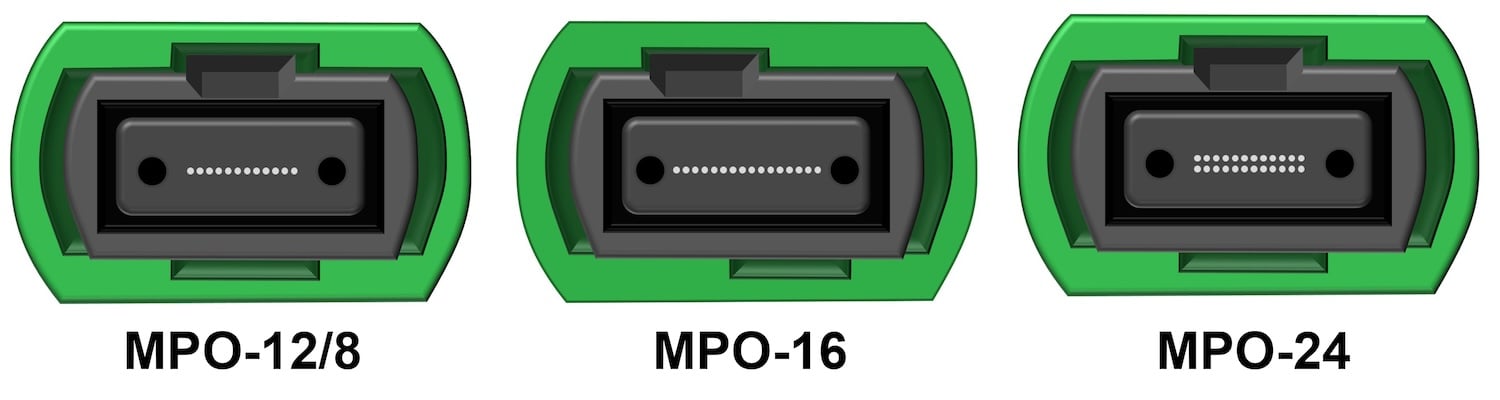
Parallel optic applications in the data center for 800G and beyond are commonly supported using MPO-12, MPO-16 and MPO-24 connectors.
To manage density and save space, many data centers are also turning to VSFF MPO connectors. The MMC from US Conec is a VSFF MPO connector that is rapidly gaining ground in single-mode parallel optic applications. Its vertical stacking approach offers three times the density of traditional MPOs.
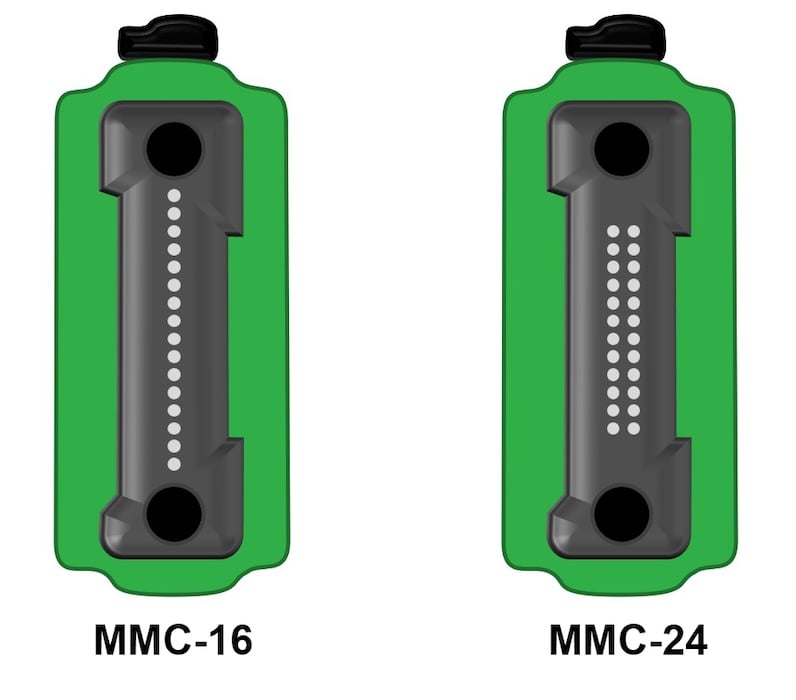
VSFF multi-fiber connectors like the MMC-16 and MMC-24 are gaining ground to save space in ultra-high-density data center environments.
How to Ensure MPO Link Integrity
Fiber certification testing that measures insertion loss and link length is the only definitive way to verify that your installed multi-fiber links meet design specifications and support the intended application. Certification testing is also essential for securing cable warranties, proving installation quality, and establishing performance benchmarks for future troubleshooting."
To accurately measure a link, testing must include the loss of both the first and last connectors. Because connector loss is calculated as a mated pair, Test Reference Cords (TRCs) are used to connect the tester to the first and last connectors of the link under test. Before testing, the tester must be calibrated to reference out the loss of the TRCs. Industry standards recommend the 1-jumper reference method, as it accounts for the loss of the connectors at both ends and offers the least uncertainty.
Verification of polarity — ensuring that the transmitter (Tx) aligns with the correct receiver (RX) — is also critical for successful data transmission. In multi-fiber environments, polarity is significantly more complex because multiple transmit and receive fibers must align across segments joined via various pinned and unpinned connector interfaces.
Equally important is inspection. Contaminated fiber end faces are a leading cause of link failure. In multi-fiber arrays, contaminants can easily migrate between fibers, causing signal loss and reflections that degrade performance or even damage ports on expensive switches and servers. Every multi-fiber connector — including those on TRCs and factory-terminated connectors fresh out of the bag — should be inspected for dirt, scratches, and other end face irregularities, then cleaned if necessary, before mating.
Must-Have MPO Tester Features
With ultra-low-loss budgets, rising fiber counts, and a mix of fiber counts and connectivity, plus shortages of skilled labor, the industry can no longer rely on legacy MPO testers. Many first- and second-generation multi-fiber testers on the market can’t keep up with today’s complex parallel optic architectures.
To ensure your tester is ready for 800G and beyond, look for these third-generation features:
-
Native support for pinned and unpinned connectors: To enable the preferred 1-jumper reference and support the full spectrum of multi-fiber architectures, your tester and TRCs should natively support all common MPO and VSFF connectivity, including pinned and unpinned versions.
-
True 1-jumper referencing: Tester inputs and TRCs that match the connector type of the link under test enable true 1-jumper reference setting for faster, more accurate testing. Older testers often require a cumbersome 3-jumper reference method involving breakout cables and substitution cords, which increases the margin for error.
-
Automatic polarity verification: Manual polarity checks on complex multi-fiber links are a recipe for mistakes. Choose a tester that verifies MPO polarity automatically during testing.
-
Intuitive interface: To combat labor shortages, your tester’s interface should be simple enough for any technician to use accurately — from selecting the application and using the correct adapter and TRC, to setting the reference and running the test.
-
Fast test-and-save time: On large projects, every second counts. A fast test-and-save time (roughly 1 second) can significantly reduce overall testing time. Just 5 extra seconds per test equates to an additional full day of labor on a 5,000-link project.
-
Integrated inspection with APC support: Since inspecting every fiber connector on links and TRCs is essential, integrated inspection cameras save time. Make sure the camera includes an APC probe tip to properly focus on single-mode multi-fiber end faces.
-
Built-in visual fault locator (VFL): A built-in VFL allows a technician to quickly verify continuity or find breaks, bends, and bad splices for failed links without switching tools.
CertiFiber™ Max: The new benchmark for MPO testing
To meet the demands of modern high-density data center environments, Fluke Networks has launched CertiFiber™ Max — the industry’s first MPO certification tester designed for the full spectrum of multi-fiber architectures supported by today’s single-mode parallel optic applications.
Built on the modular Versiv™ platform, the CertiFiber Max natively supports pinned and unpinned MPO-12, MPO-16, and MPO-24 connectivity, as well as 16- and 24-fiber MMCs. With tool-free swappable UniPort™ adapters and matching TRCs, CertiFiber Max enables a true 1-jumper reference for precise insertion loss and length measurements at both 1310 and 1550 nm wavelengths.
CertiFiber Max delivers the fastest test-and-save time of just 1 second. It automatically verifies complex multi-fiber polarity, features a built-in VFL, and integrates with the Fluke Networks FiberInspector™ Ultra Camera for easy inspection. It features an intuitive, easy-to-use interface with a Set Reference Wizard that offers step-by-step, color-coded animation to prevent errors. CertiFiber Max even tracks how many tests you perform with your TRCs, to ensure that contaminated or degraded TRCs never compromise your results, as well as time elapsed since the reference was set, to ensure you meet your customer’s requirements.
Finally, integrated Wi-Fi connectivity allows you to upload results from your CertiFiber Max directly to LinkWare™ Live. This cloud-based management service streamlines testing by allowing you to remotely configure testing parameters and cable IDs, assign projects, track tester status, upload and consolidate test results from multiple testers, and generate professional certification reports.
When it comes to testing 800G and beyond, CertiFiber Max isn’t just ready — it’s the new benchmark.