Fiber Optic Cleaning Kits
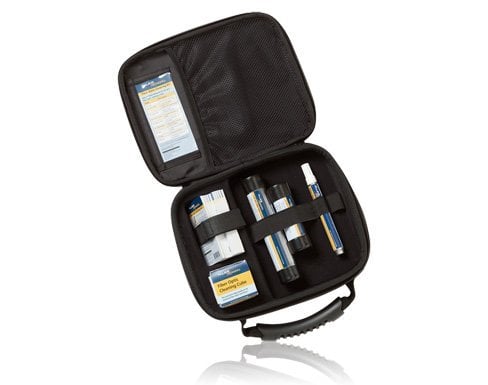

Product Highlights
The complete solution for precision end-face fiber optic cable cleaning.
- Each fiber cable cleaner kit includes the supplies you need to eliminate the #1 cause of fiber optic link failure: contamination
- Cleans all fiber connector types in data center and campus environments
- Quick Clean™ Cleaners —no training required
- Solvent pen precisely dispenses specially formulated fiber optic cleaning solution
- Optical Fiber Cable (OFC) cleaner cards for convenient cleaning of fiber end faces View More >
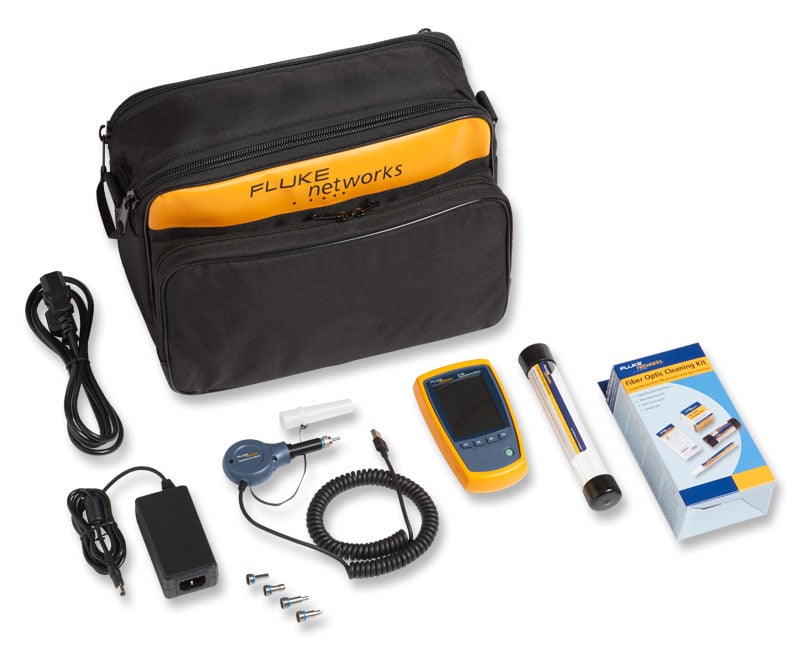
- Rugged NFC kit case stores and transports all fiber optic cleaning tools and supplies
Overview
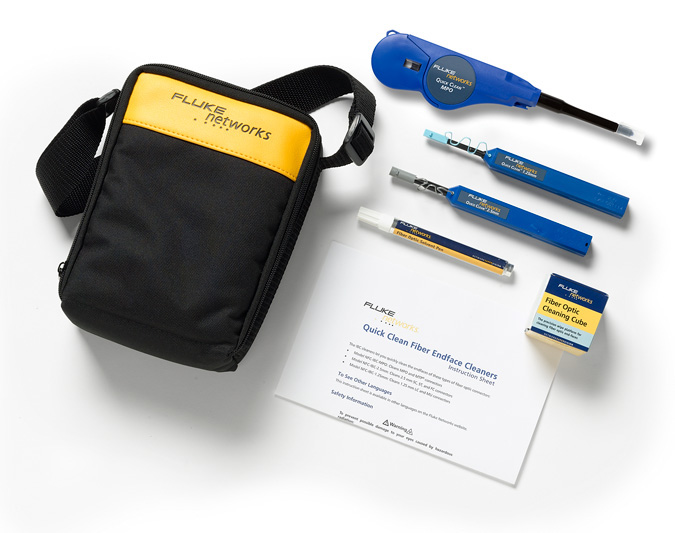
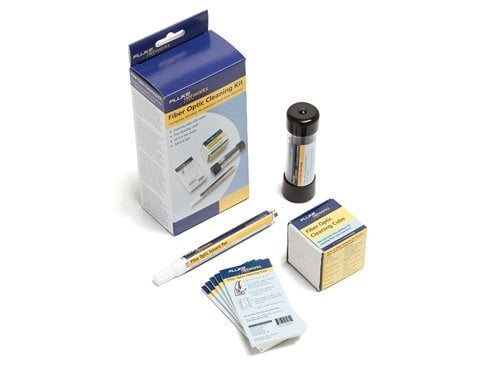
Fluke Networks Fiber Optic Cleaning Kits contain the best fiber optic cleaning tools and products to effectively remove the toughest contaminants in any optical fiber cable (OFC) network. With a variety of kit options available, you can choose between the easy-to-use Quick Clean™ Cleaners, the convenient cleaning cube/card, and the best optic solvent pen to clean both patch cords and fiber end faces inside ports. Each of the eight fiber optic cleaning kits include products and materials that are lint-free and enable an optimal wet or dry cleaning process.
These customized solvents are more effective than the old isopropyl alcohol (IPA) method used to clean fiber end faces. These new solvents are more effective than IPA at dissolving many contaminants found on optical fiber cables, especially non-ionic compounds like bugger gel and pulling lube.
Kit Components
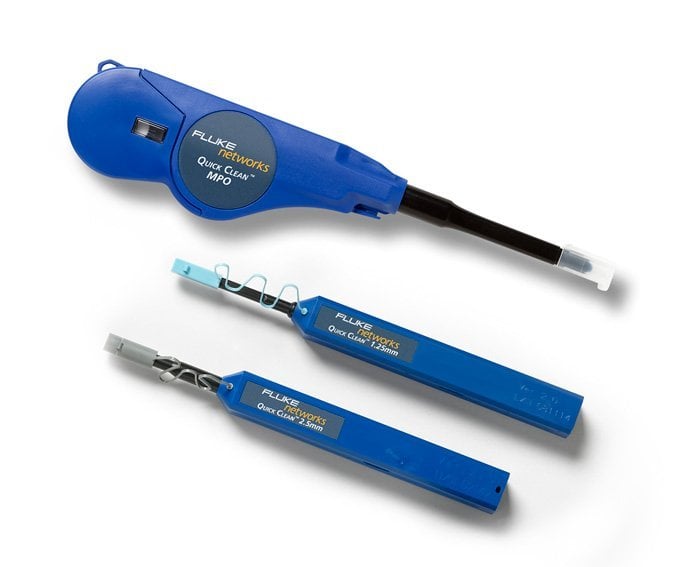
Quick Clean cleaning tool
- Depending on which kit you purchase, there are different types of Quick Clean cleaning tools included. Each is made with a proprietary lint-free cleaning strand to ensure your end faces remain as clean as possible.
Quick Clean 1.25 mm
- Each unit cleans a minimum of 500 end faces
- Dimensions: 0.69” x 0.69” x 7.05”
Quick Clean 2.5 mm
- Each unit cleans a minimum of 500 end faces
- Dimensions: 0.69” x 0.69” x 7.05”
Quick Clean LC Duplex
- Each unit cleans a minimum of 1050 end faces (525 connectors)
- Dimensions: 0.71” x 1.2” x 8.1"
Quick Clean MDC
- Each unit cleans a minimum of 1050 end faces (525 connectors)
- Dimensions: 0.71” x 1.2” x 9.1"
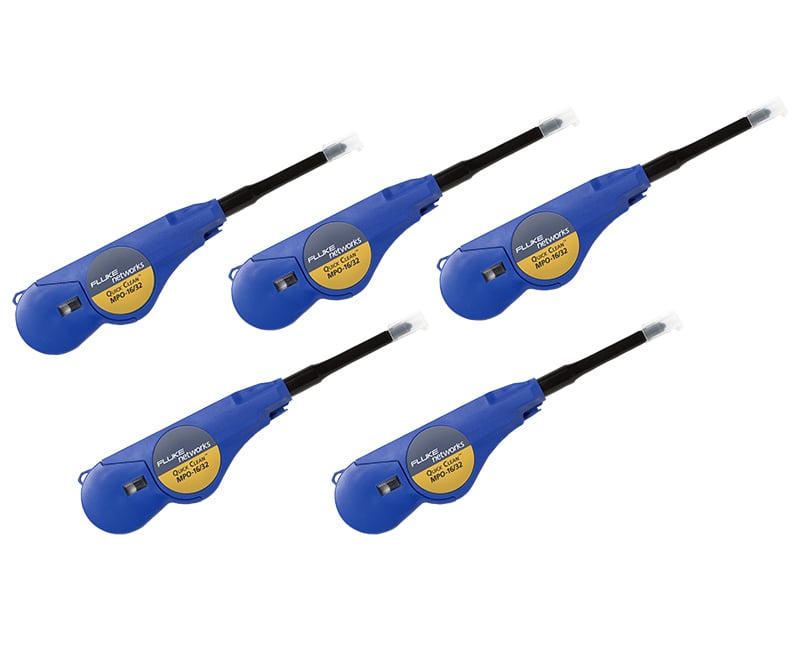
Quick Clean MPO
- Each unit cleans a minimum of 600 end faces
- Dimensions: 0.87” x 2.22”x 7.46”
Quick Clean MMC
- Each unit cleans a minimum of 600 end faces
- Dimensions: 0.87” x 2.22”x 7.46"
Solvent pen
- The solvent pen contains 9 grams of fiber optic solvent dispensed through a felt tip. The aluminum pen pody is spring-activated to dispense the proper amount of cleaning solution for your fiber end faces.
- Dimensions: 5.5” x 0.5” diameter
Cleaning cube
- The Fluke Networks Cleaning cube offers 125 wipes, each capable of cleaning up to four (4) end faces. These 2” x 2” x 2” cubes are made with lint-free 55% cellulose/45% polyester.
Cleaning card
- For kits that include the cleaning card, you get 12 cleaning zones on a small, easy-to-carry card. Made of lint-free 55% cellulose/45% polyester.
- Dimensions: 3.75” x 2” x 0.1”
Swabs
- Included with the Fiber Optic cleaning kit, these swabs are made for precision cleaning and getting into those hard-to-reach, recessed areas
Swabs – 2.5 mm
- Contents: 50 swabs
- Dimensions: 4.0” x 1.0” diameter
- Material: 100 ppi medical grade polyurethane sealed foam
Swabs – 1.25 mm
- Contents: 25 swabs
- Dimensions: 6.5” x 1.0” diameter
- Material: Proprietary compressed polyester fiber
Cases
- To keep all your cleaning materials organized, a couple of the cleaning kits include cases. Either a rugged, hard-side carrying case or a soft-side case.
Top-selling Kits
NFC Kit Case
Fiber Optic Cleaning Kit - Includes
- Cleaning cube with wipes
- Ten (10) cards with sealed cleaning zones
- Solvent pen
- 2.5 mm port cleaning swabs
- 1.25 mm port cleaning swabs
- Rugged carrying case
NFC Kit Box
Fiber Optic Cleaning Kit - Includes
- Cleaning cube with wipes
- Five (5) cards with sealed cleaning zones
- Solvent pen
- 2.5mm port cleaning swabs
NFC Kit Box E
Enhanced Fiber Optic Cleaning Kit - Includes
- Quick Clean 1.25 mm cleaner
- Quick Clean 2.5 mm cleaner
- Quick Clean MPO cleaner
- Solvent pen
- Cleaning cube
- Soft case.
What Causes Fiber Optic Link Failure?
Contamination is the #1 cause of fiber optic link failure. Dirt, dust and other contaminants are the enemies of high-speed data transmission over optical fiber. Today’s OFC network applications require more bandwidth than ever, making loss budgets tighter than ever. That’s why it is critical that all optical connections are free of contaminants to avoid having application performance issues.
Learn how to clean OFC end faces and fix link failures
Where to Buy
Features
End Face Fiber Optic Cable Cleaning Instructions
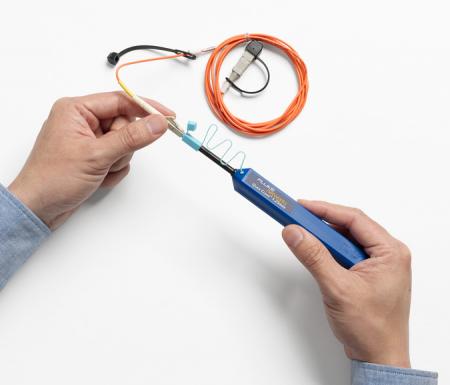
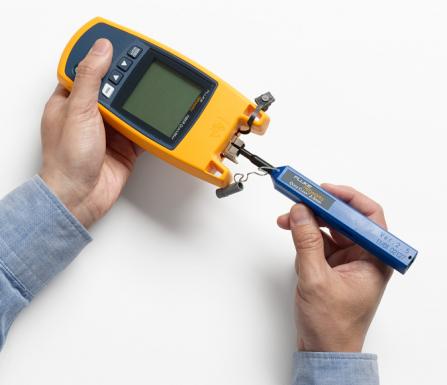
Clean OFC End Faces with the Quick Clean 1.25mm or 2.5mm Cleaner:
- To begin end face fiber optic cable cleaning, open or remove the guide cap from the Quick Clean Cleaner.
- Push the cleaner straight into the connector and you will a hear a click to confirm cleaning.
Cleaning a fiber end face with the Quick Clean fiber cleaner tool
The Quick Clean fiber port cleaner cleaning a Fluke fiber optic tester
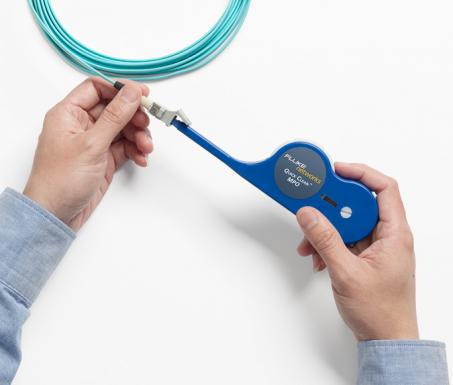
Clean OFC End Faces with the Quick Clean MPO Cleaner:
- Open or remove the guide cap from the Quick Clean Cleaner.
- Push the cleaner straight into the connector.
- The Quick Clean is a one click fiber cleaner – just turn the dial until you hear a click to confirm cleaning.
The Fluke Networks Quick Clean MPO end face fiber cleaner
Inspect every end-face first. If it is clean, then it can be inserted as is. Most likely, it has accumulated some form of contamination and needs to be cleaned right before insertion:
Cleaning patch cords with a fiber optic Cleaning Card:
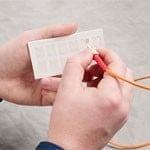
- Remove the plastic cover from one cleaning zone.
- Apply a minimal spot of solvent to the starting corner of the cleaning zone.
- Holding the connector perpendicularly, swipe the end-face from the wet spot into a dry zone.
- Inspect again to ensure a complete cleaning. If necessary, expose a new cleaning zone and repeat steps again.
Cleaning patch cords with a fiber Cleaning Cube:
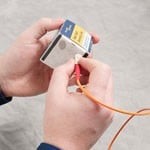
- Pull a clean wipe or sheet from the Cleaning Cube.
- Apply a minimal spot of solvent to the starting edge of the wipe.
- Holding the fiber connector perpendicularly, swipe the end-face from the wet spot into a dry zone.
- Inspect again to ensure a complete cleaning. If necessary, repeat the steps again on a new portion of the exposed wipe on the Cube.
Cleaning inside ports with fiber optic cleaning Swabs:
- Pull a clean wipe from the Cleaning Cube.
- Apply a minimal spot of solvent to the wipe.
- Touch the swab to the wet spot on the wipe for 3 seconds to absorb a minimal amount of solvent. A damp swab works better than a wet one.
- Insert the swab into the port and turn several times while applying gentle pressure.
- Follow the damp swab with a dry one, using the same procedure to remove any remaining solvent from the end-face and alignment sleeve.

* Note that applying solvent directly from the fiber optic cleaning pen to a swab will result in excess solvent on the swab.
What to Avoid When Cleaning Fiber Cable End-faces
There are as many different cleaning techniques as there are fiber optic network technicians. While some techniques work some of the time, reliable and lasting performance of your fiber links require inspection and proper cleaning processes with every mating. Here are some well-known bad habits:
Dry Cleaning:
Traditionally, dry cleaning has been proven to be only partially effective in eliminating contaminants from fiber end-faces and connectors. The challenge had been that the dry cleaning materials were either not good enough to uplift the various types of dirt or greasy contaminants, or they actually introduced static to the fiber ferrule that attracts dust. With technological advancement and better dry cleaning materials, however, a new class of fiber cleaning tools have been created to provide a cost effective and efficient solution for cleaning more than 50% of contaminants from optical networks. It is therefore very important to avoid using simple swabs or cleaning papers to perform dry cleaning on any fiber connectors. Instead, use Fluke Networks’ Quick Clean Cleaner to eliminate most of the dust and harmful particles in your fiber plant.
Wet Cleaning:
Cleaning with only a pre-soaked wet wipe or excessive solvent will leave liquid behind on the end-face which also causes problems. As that excess solvent dries, it can leave behind of film of dissolved contaminants that were never properly removed. In addition, residual isopropyl alcohol (IPA) can leave behind a “halo” as it dries that not only causes attenuation, but also can be very hard to remove. No solvent should remain at the conclusion of a cleaning.
Canned Air and Dusters:
Canned air and dusters are ineffective and should not be used to clean end-faces. The only thing dusters do is blow large particles around. On a patch cord, this may be effective, but inside a port this can result in those same particles settling elsewhere. Dusters are ineffective on smaller, statically-charged particles and totally useless on oil-based contaminants such as buffer gel or body oil. Finally, dusters often expel a propellant that becomes a whole new contaminant that now requires an effective cleaning process to remove.
Thinking New Equals Clean:
Do not be lulled into thinking that end-faces on factory-terminated patch cords or pigtails will be clean when they are brand new and covered with a dust cap. Though fiber dust caps are great at preventing damage to the end-face, the caps themselves can be a source of contamination. The plastic used to create dust caps will outgas a residue as its plasticizers deteriorate over time and the surface of the cap may contain mold-release substances used in their high-speed production process. Don’t be surprised to find a contaminated end-face upon removal of a protective cap. For repeatable and reliable end-face cleaning, always use Fluke Networks’ fiber optic cleaning tools to follow the recommended wet and dry process.
NFC Fiber Optic Solvent Pen with Specialized OFC Cleaner
For years isopropyl alcohol (IPA) fluid was used to clean fiber end-faces, but now there are customized solvents that are far superior, such as Fluke Networks’ Fiber Optic Solvent Pen. Most importantly, Fluke’s specialized OFC cleaner solvent is more effective than IPA at dissolving all contaminants, especially non-ionic compounds such as buffer gel and pulling lube. You will get a better clean every time and with every contaminant by using Fluke’s fiber optic cleaning pen.
Next, the solvent in our fiber cleaning pen has a lower surface tension than IPA that allows it to envelop particles and debris, effectively lifting them from the surface of the end-face as they are carried away by a fiber wipe or swab. Many smaller particles carry a charge that bonds them to the ferrule or an end-face. Unlike IPA, this solvent is oxygenated to neutralize this charge so that the charged particle can be removed, and more particles are not attracted onto the end-face. When cleaning fiber end-faces inside ports or equipment, the evaporation rate of solvents become significant as it is harder to guarantee removal of all solvent. Fluke Networks’ customized solvent has an evaporation rate tailored to stay long enough to work yet still disappear before mating. It evaporates much faster than IPA. IPA is highly hygroscopic and therefore draws water vapor that can then dry on the end-face and leave a residue, which sometimes appears as a “halo”. Using Fluke Networks’ fiber cleaning pen with specialized cleaning solvent will avoid this problem.
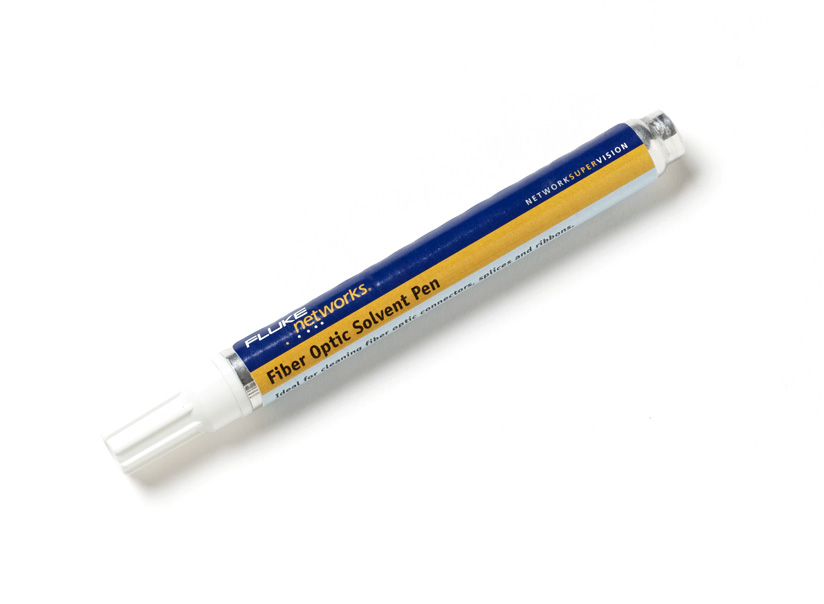
Fluke Networks fiber optic cleaning pen
Models & Accessories
Models
NFC-Kit-Box
NFC-Kit-Box
FI-525 GOLD
FI-525 Gold Support
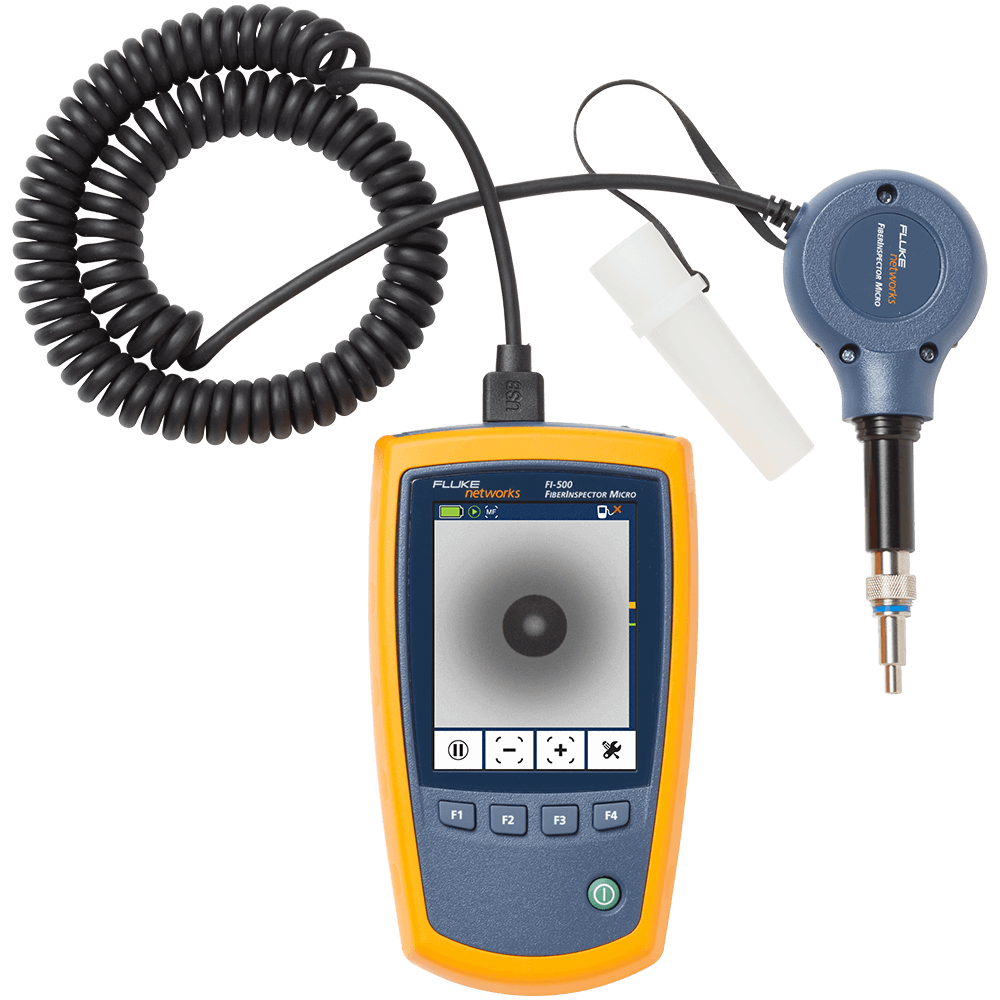
FiberInspector Micro and Cleaning Kit (NFC-KIT-BOX) and 1.25 mm swabs See Photo
Gold Support available for FI-525
NFC-Kit-Case
NFC-Kit-Case
NFC-Kit-Case-E
NFC-Kit-Case-E
Accessories
FT525-Case
FT525-Case
NFC-Cards-5pack
NFC-Cards-5pack
NFC-SolventPen
NFC-SolventPen
NFC-Cube
NFC-Cube
NFC-Swabs-1.25mm
NFC-Swabs-1.25mm
NFC-Swabs-2.5mm
NFC-Swabs-2.5mm
NFC-Case
NFC-Case
QuickClean-1.25-5P
QuickClean-1.25-5P
QuickClean-2.5-5P
QuickClean-2.5-5P
QuickClean-1.25-1P
QuickClean-1.25-1P
QuickClean-2.5-1P
QuickClean-2.5-1P
QC-MPO-12/24-1P
QC-MPO-12/24-1P
QC-MPO-12/24-5P
QC-MPO-12/24-5P
QC-MPO-16/32-1P
QC-MPO-16/32-1P
QC-MPO-16/32-5P
QC-MPO-16/32-5P
QC-LC-Duplex-1P
QC-LC-Duplex-1P
QC-LC-Duplex-5P
QC-LC-Duplex-5P
QC-MDC-1P
QC-MDC-1P
QC-MDC-5P
QC-MDC-5P
QC-MMC-12-24-1P
QC-MMC-12-24-1P
QC-MMC-12-24-5P
QC-MMC-12-24-5P
QC-MMC-16-1P
QC-MMC-16-1P
QC-MMC-16-5P
QC-MMC-16-5P
Specifications
Specifications
| Quick Clean 1.25mm | Contents: Each unit cleans a minimum of 500 end faces |
| Quick Clean 2.5mm | Contents: Each unit cleans a minimum of 500 end faces Dimensions: 0.69” x 0.69” x 7.05” Material: Proprietary lint-free cleaning strand |
| Quick Clean MPO | Contents: Each unit cleans a minimum of 600 end faces Dimensions: 0.87” x 2.22”x 7.46” Material: Proprietary lint-free cleaning strand |
| Cleaning Card | Contents: 12 cleaning zones Dimensions: 3.75” x 2” x 0.1” Material: Lint-free 55% cellulose/45% polyester |
| Cleaning Cube | Contents: 125 wipes – each cleans up to 4 end-faces Dimensions: 2” x 2” x 2” Material: Lint-free 55% cellulose/45% polyester |
| Solvent Pen | Contents: 9 grams of fiber optic solvent Dispenser: Felt-tip, spring-activated valve in aluminum pen body Dimensions: 5.5” x 0.5” diameter |
| Swabs – 2.5mm | Contents: 50 swabs Dimensions: 4.0” x 1.0” diameter Material: 100ppi medical grade polyurethane sealed foam |
| Swabs – 1.25mm | Contents: 25 swabs Dimensions: 6.5” x 1.0” diameter Material: Proprietary compressed polyester fiber Dimensions: 0.69” x 0.69” x 7.05” Material: Proprietary lint-free cleaning strand |
| Quick Clean 2.5mm | Contents: Each unit cleans a minimum of 500 end faces Dimensions: 0.69” x 0.69” x 7.05” Material: Proprietary lint-free cleaning strand |
| Quick Clean MPO | Contents: Each unit cleans a minimum of 600 end faces Dimensions: 0.87” x 2.22”x 7.46” Material: Proprietary lint-free cleaning strand |
| Cleaning Card | Contents: 12 cleaning zones Dimensions: 3.75” x 2” x 0.1” Material: Lint-free 55% cellulose/45% polyester |
| Cleaning Cube | Contents: 125 wipes – each cleans up to 4 end-faces Dimensions: 2” x 2” x 2” Material: Lint-free 55% cellulose/45% polyester |
| Solvent Pen | Contents: 9 grams of fiber optic solvent Dispenser: Felt-tip, spring-activated valve in aluminum pen body Dimensions: 5.5” x 0.5” diameter |
| Swabs – 2.5mm | Contents: 50 swabs Dimensions: 4.0” x 1.0” diameter Material: 100ppi medical grade polyurethane sealed foam |
| Swabs – 1.25mm | Contents: 25 swabs Dimensions: 6.5” x 1.0” diameter Material: Proprietary compressed polyester fiber |
Documents
Manuals
- Material Safety Data Sheet Fiber Optic Solvent Pen
- Quick Clean Instruction Sheet, Rev. 1 User documentation
- Foglio di istruzioni del Quick Clean, Rev. 1 Documentazione per l'utente
- FiberLert-125 QRG
- FiberLert-125 Safety Information
Data Sheets
- Datasheet: Quick Clean™ Cleaners Solution Fluke Networks' family of mechanical cleaning tools designed to clean fiber optic connector end faces on patch cables, within adapters or patch panels.
- Safety Data Sheet for Pen Precision Cleaner
White Papers
- White Paper: Standard-Compliant Certification & Best Practices White Paper: Standard-Compliant Certification & Best Practices Ensure Fiber End-face Cleanliness to Eliminate the #1 Cause of Fiber Failure
Application Notes
- Application Note: How to Choose the Right Power Meter Light Source Top 4 Questions to Ask a Power Meter Light Source Vendor
- Fiber Testing Best Practices - Pocket Guide Request your 4” x 6”, sturdy pocket guide that is ideal to take on all your fiber jobs. Includes a quick-action summary and checklist, this guide is an invaluable tool to ensure you never miss a critical step during your fiber testing or troubleshooting.
Flyers
- Outfit Your Data Center - Flyer Outfit Your Data Center and Save Up to 15%*
_0.jpg)