
Was it just yesterday that 400 Gigabit (G) applications arrived? Now data centers are rapidly migrating to 800G and 1.6 Terabit (T) switch speeds to support their high-performance workloads. Big players (Amazon, Google, Meta, et al.) are already eyeing 3.2T. The IEEE 802.3df 800G standard (2024) and ongoing advancements in signaling technology offer data centers multiple options for deploying increased speeds — with considerations. Let's take a closer look.

Data centers need more speed
Enterprise data centers have been adopting 400G Ethernet for switch-to-switch links over the past few years. With 800G being an ideal technology for 8x100G and 2x400G breakout applications in switch-to-server links, 800G is now starting to see adoption at the enterprise level — especially among larger enterprises that are experimenting with on-premises AI. These pioneering enterprise data centers will likely adopt 1.6T speeds sooner rather than later.
According to the latest Optical Components Report from research firm Cignal AI, 800G will be the fastest-growing segment of the market in 2025, with transition to 1.6T starting in Q3 and ramping up in 2026 and 2027. This aligns with 400G, 800G, and 1.6T (1600G) port shipment forecasts published by Dell'Oro Group.
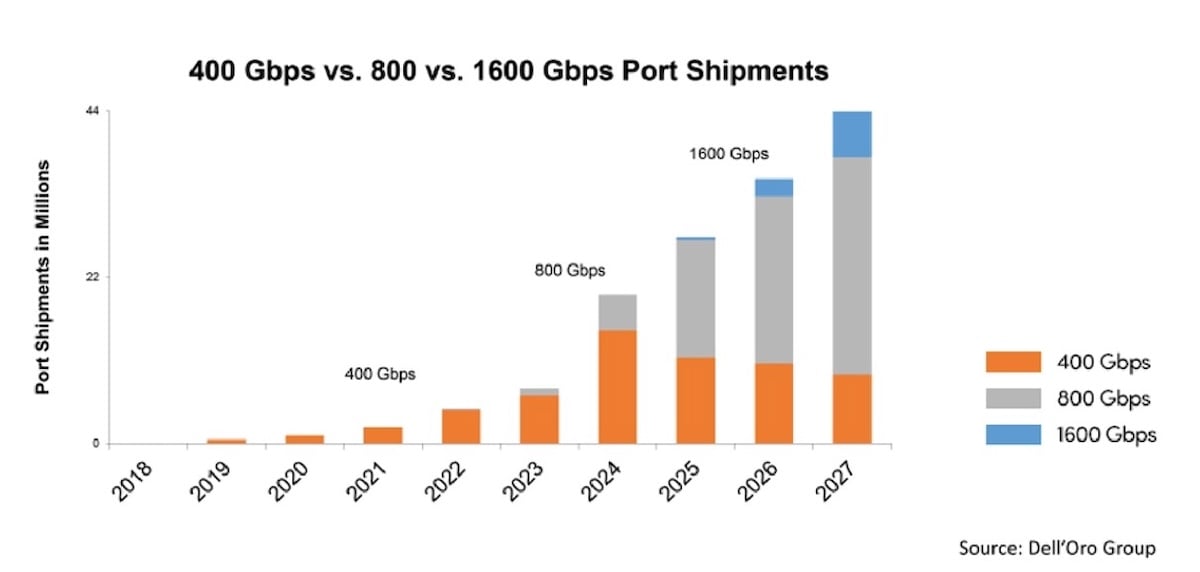
800G is the fastest growing segment of the switch port market in 2025, with 1.6T expected to ramp up over the next two years. Source: Dell'Oro Group.
Options to choose from
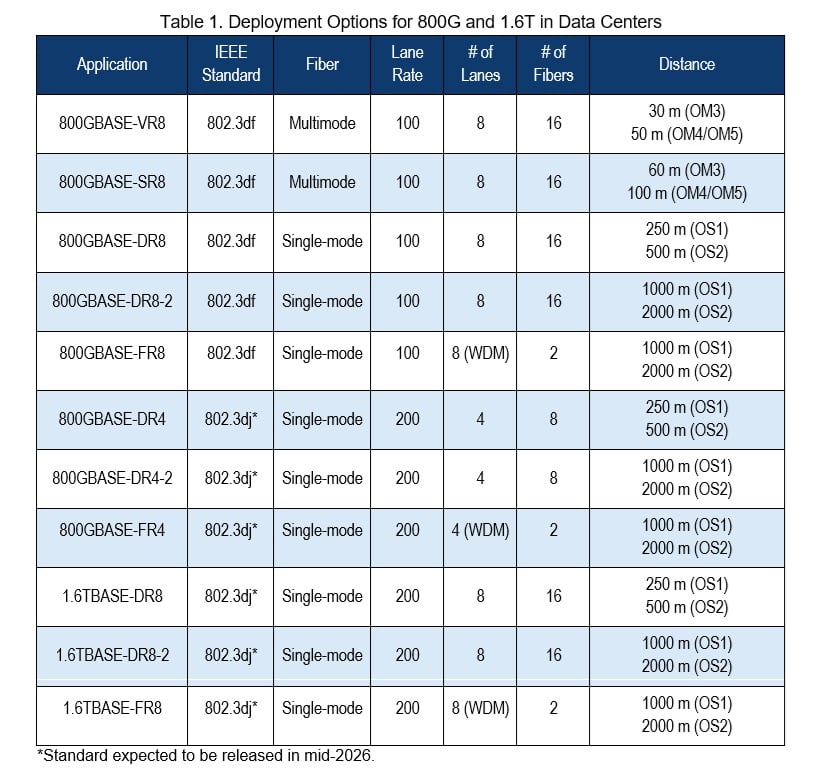
The development of four-level pulse amplitude modulation (PAM4) signaling technology, which enables 100 Gigabit per second (Gb/s) per lane, paved the way for 8-lane 800G multimode and single-mode parallel optic applications using 16 fibers (8 transmitting at 100 Gb/s and 8 receiving at 100 Gb/s). It also enabled an 8-lane 800G single-mode course wavelength division multiplexing (CWDM) application using eight distinct wavelengths over duplex fiber. Since the ratification of 802.3df, the industry has successfully achieved 200 Gb/s per lane PAM4 signaling technology via advancements in optical and digital signal processing technologies.
The IEEE 802.3dj 1.6T standard, based on 200 Gb/s per lane, is now expected to be released by mid-2026. Several switch manufacturers already offer 1.6T transceivers based on this signaling technology. Broadcom released its 1.6T transceivers in September 2024, and several others followed suit.
Table 1 outlines the various options for deploying 800G and 1.6T in data center environments.
Key infrastructure considerations
Data centers looking to migrate to 800G, and eventually 1.6T applications have several key fiber infrastructure considerations.
Density
Multimode fiber infrastructure currently supporting 400G over 8 fibers (400GBASE-SR4) will require twice the amount of fiber to support 800G. While there are options for supporting 800G with two MPO-8/12 connectors, 16-fiber connectivity provides higher density. To save space, data centers may want to consider 16-fiber very small form factor (VSFF) connectors, such as the SN-MT or MMC, which are available in multimode.
Connectivity
While WDM applications will allow for 800G and beyond using duplex connectors, parallel optics will remain the primary approach for data center links due to cost and limited need for distances beyond 2000 meters. Multi-fiber connectors will therefore continue to be the de facto interface.
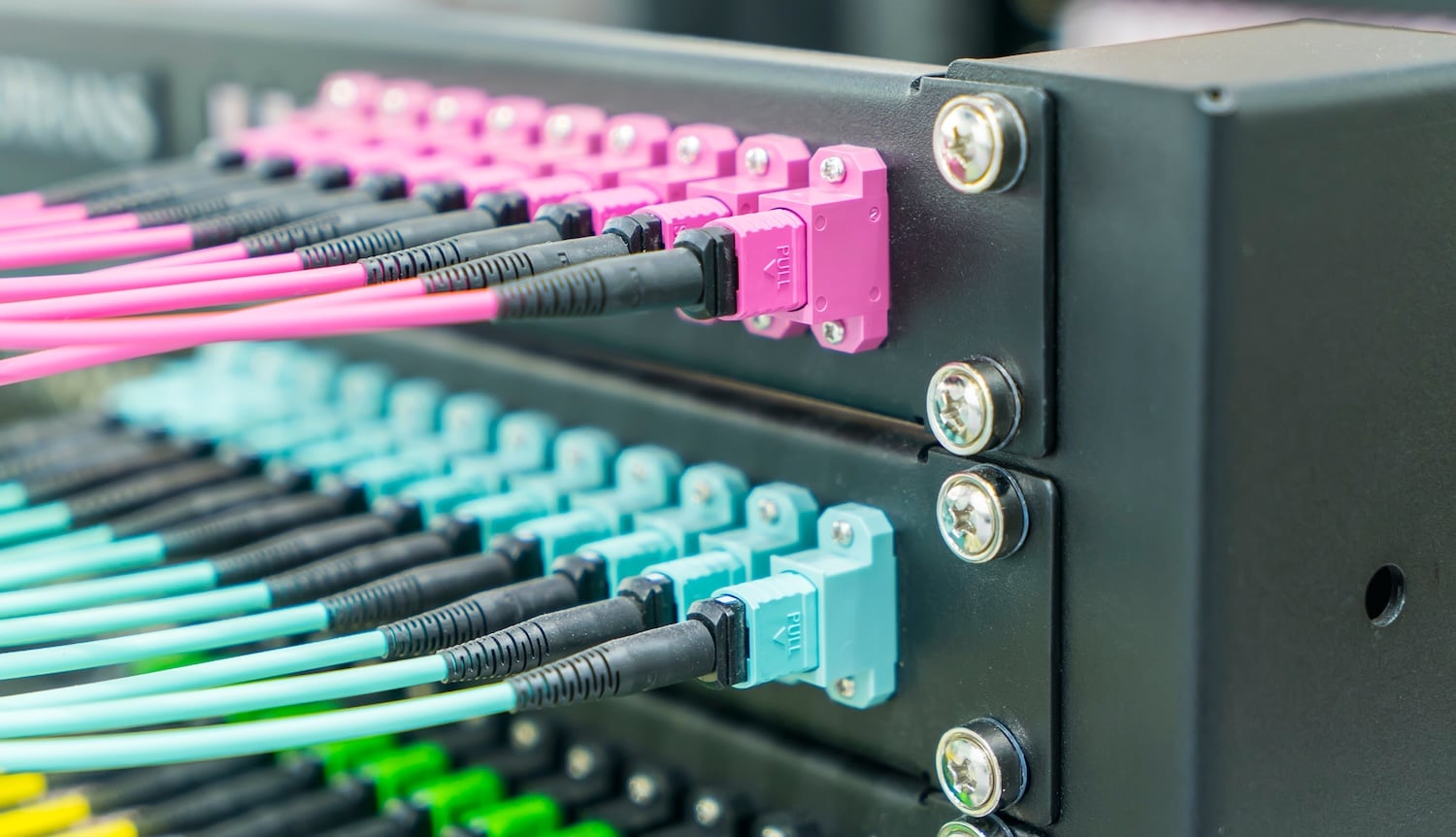
Parallel optics and multi-fiber connectors will remain the primary approach in the data center for 800G and beyond.
While typically associated with single-mode fiber applications, APC (angled physical contact) multimode MPO connectors gained popularity in 400G multimode deployments to help limit reflections, as opposed to the commonly used UPC (ultra-physical contact) fiber end face. This trend will likely continue for 800G multimode applications.
The end face of an APC connector features an 8-degree angle that causes reflected light to be absorbed into the cladding. Data centers looking to test multimode links using APC connectors must ensure that their tester supports them, which may require the use of a UPC-to-APC hybrid test reference cord. Because the input port in the Fluke Networks CertiFiber™ Pro is non-contact, such a cable can be used to set a 1-jumper reference. An APC probe tip is also essential for inspecting these connectors, as a UPC probe can hinder focusing on the core and end face.
Link length and loss
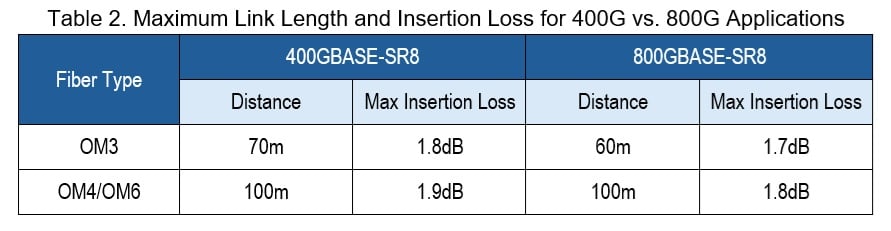
Another consideration is the difference in maximum link length and insertion loss for 800G multimode applications. As shown in Table 2, OM3 supports 16-fiber 400GBASE-SR8 up to 70 meters with a maximum insertion loss of 1.8 dB, but it only supports 16-fiber 800GBASE-SR8 up to 60 meters with a maximum insertion loss of 1.7 dB. Distance limitations for OM4/OM5 fiber remain at 100m for both 400G and 800G, but insertion loss values decrease from 1.9 dB for 400GBASE-SR8 to 1.8 dB for 800GBASE-SR8. Data centers looking to transition to 800G will need to verify the length of their OM3 links and test all multimode links for insertion loss to determine if they can support 800G. These more stringent loss budgets also demand accurate loss testing using a 1-jumper reference method, as well as verified clean connectors on test reference cords, tester inputs, and the link under test.
Another consideration is the use of FR4 and FR8 CWDM single-mode applications that transmit and receive over 4 or 8 wavelengths on duplex fiber. FR4 applications use the 1271nm, 1291nm, 1311nm, and 1331nm wavelengths, while FR8 adds the 1351nm, 1371nm, 1391nm, and 1411nm wavelengths. Testing for these applications should be done at both the 1310nm and 1550nm wavelengths, which is generally sufficient to cover all the wavelengths used in them.
It's important to note that the upcoming IEEE 802.3dj standard, which aims to support 800G and 1.6T with a 200 Gb/s lane rate, currently addresses only single-mode fiber. Although there is some speculation in the industry that short-reach multimode will be considered in the future for higher lane rate applications, data centers looking to deploy 800G or 1.6T networks in support of HPC workloads may want to consider single-mode to ensure ongoing support as speeds continue to climb.
Connector reflectance
Reflectance is a key consideration in short-reach single-mode DR applications. Because the low-cost transceivers used in these applications cannot tolerate reflections, the IEEE has specified loss limits based on the number and reflectance of connections. For 800GBASE-DR8 and DR8-2, IEEE allows only two discrete reflectance values of -31 dB but allows eight discrete reflectance values of -40 dB.
To measure the reflectance of each connector along the link, use an Optical Time Domain Reflectometer (OTDR). This is often called "Tier 2" testing, which is employed as an additional measurement to the "Tier 1" testing that measures link loss using an Optical Loss Test Set (OLTS). Because discrete (individual) connector reflectance is a much greater concern than channel return loss in any short-reach single-mode application, these applications can benefit from a comprehensive testing strategy using both an OLTS and OTDR.
Migrating a data center to 800G and beyond requires planning
Migrating to 800G and 1.6T applications requires careful planning and potentially significant infrastructure upgrades and investment, depending on the current status of the data center. These more complex applications also come with greater power consumption, which can require advanced cooling solutions.
And it won't end there. Switch manufacturers are already working on 400 Gb/s per lane signaling technology as a means to achieve 3.2T over 8 lanes (16 fibers). The need for these speeds is being driven by advanced AI-driven workloads, which are already experiencing bottlenecks at 400G and 800G. While 400 Gb/s per lane will introduce additional signal integrity challenges, power consumption, and cost, the good news is that when that day comes, the data center fiber infrastructure that supports 800G and 1.6T today should have no problem supporting 3.2T tomorrow.
Regardless of where you are on your journey toward 800G and beyond, ensuring signal integrity for these ultra-high-speed links will remain a priority — and require advanced multi-fiber test equipment from leaders like Fluke Networks.